
Memory Foam vs EVA Slippers: Which Material Wins?
One hugs your foot like a mattress, the other springs back like a pool slide. Memory foam and EVA make completely different slippers — here is how to pick your side.
Step into a memory foam slipper and it greets you like a hotel bed — a slow, warm hug that moulds to every contour of your foot. Step into an EVA pair and you get something completely different: a light, springy platform that bounces back the instant you lift your heel. Same job title, wildly different personalities — and picking the wrong one for your routine is the fastest way to be disappointed by a “comfortable” slipper.
Two foams, two personalities
Memory foam (viscoelastic polyurethane, if you want to win a pub quiz) responds to heat and pressure — it compresses slowly, holds the shape of your foot, and recovers gradually. EVA foam is the opposite: a closed-cell foam that compresses instantly and springs straight back. One remembers; one rebounds. Everything else about these two slipper types flows from that single difference.
The case for memory foam
For pure standing-still, sinking-in comfort, memory foam is untouchable. It spreads pressure beautifully across the whole sole — lovely for bony feet, cold evenings, and the sofa-to-kettle lifestyle. It also pairs naturally with plush fabric uppers, which is why the cosiest cloud-style slippers and winter pairs lean this way. The catch: it absorbs moisture and heat, compresses permanently over time, and most of it can’t be machine washed without turning to sadness — check our slipper cleaning guide before you try.
The case for EVA
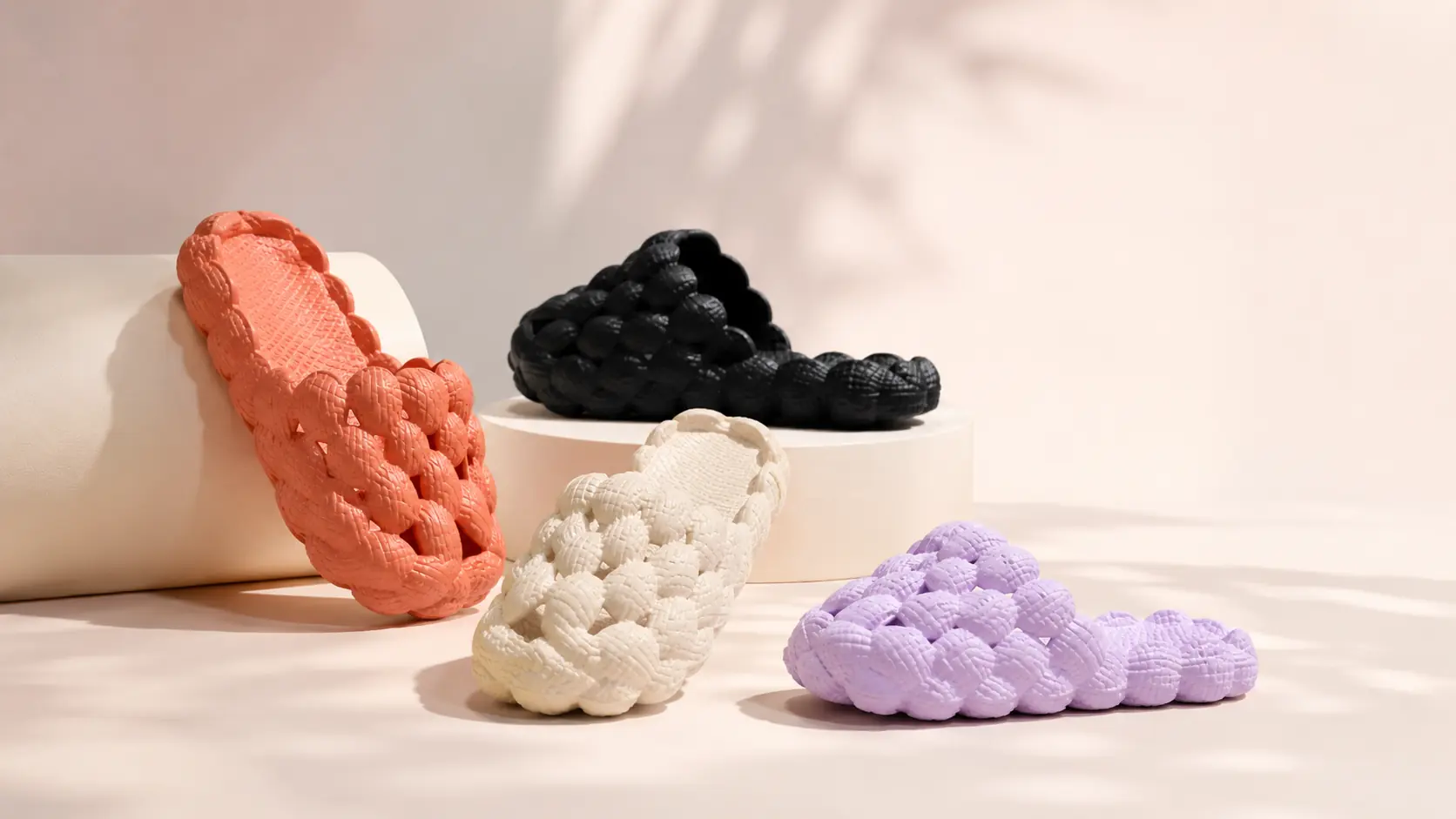
EVA is the material of doing things. It’s featherlight, waterproof, wipes clean in seconds, and its instant rebound gives you energy back with every step — which is why virtually every bubble slide and pool slide on earth is EVA. It shrugs off wet bathroom floors, muddy doorsteps and dishwater. The trade-off: that first-step “ahhh” is less dramatic, and cheap EVA can feel hard by evening. Quality matters more here than with any other slipper material.
Head to head
| Factor | Memory foam | EVA |
|---|---|---|
| First-step feel | Deep, slow hug | Light, springy |
| Long-wear support | Flattens as it warms | Consistent rebound |
| Moisture & smells | Absorbs both | Repels both |
| Cleaning | Delicate, often hand-only | Rinse and go |
| Warmth | Excellent | Modest |
| Lifespan of comfort | Shorter — permanent compression | Longer at equal quality |
| Best for | Cosy, low-mileage home time | Busy homes, kitchens, wet rooms |
The honest answer: cosy maximalists should go memory foam and treat pairs as semi-disposable; practical households should go quality EVA and enjoy years of wipe-clean service. Cold-floor sufferers can hedge with our cold floors guide — insulation strategy matters as much as foam choice.
Quick FAQ
Is memory foam better for foot pain?
Not automatically. Memory foam relieves pressure points but offers little structure — feet that need arch support usually do better on a shaped EVA footbed than on flat plushness.
Why did my memory foam slippers go flat?
That’s the material working as designed — viscoelastic foam takes a permanent “set” with repeated compression. When the hug stops hugging, it’s replacement time; our guide on when to replace slippers covers the other signals.