
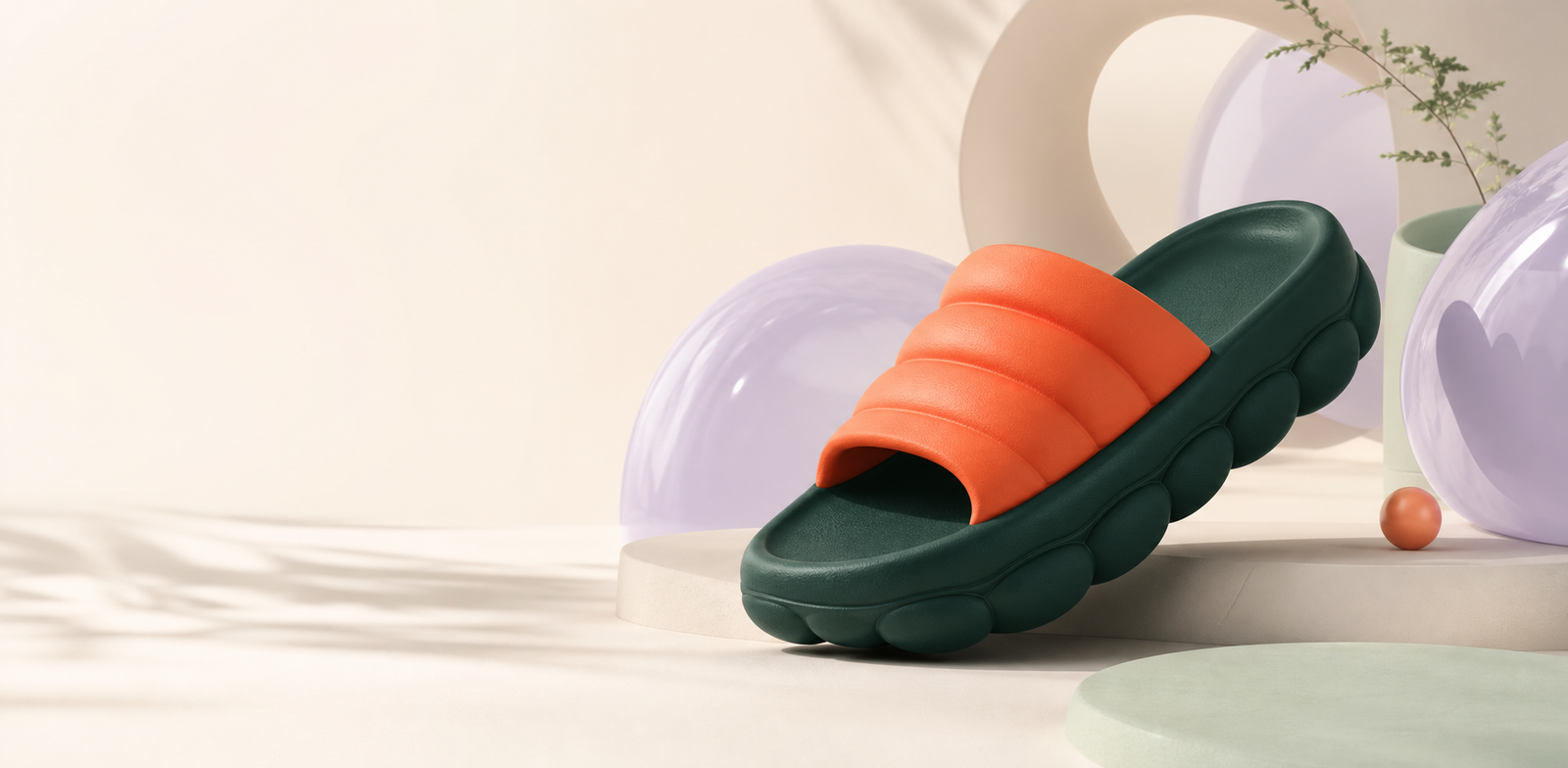
Best Slippers for Wide Feet and Bunions — Footbeds That Actually Fit
Wide feet and bunions need different things from a slipper. This guide explains what to look for in the footbed, toe box, and upper — and picks five options that get it right.
Bunions and wide feet are different problems that tend to overlap. A bunion (hallux valgus) is a bony prominence at the base of the big toe joint, caused by misalignment of the metatarsophalangeal joint. Wide feet (EE width or above) are simply a structural variation. Both create the same practical problem with footwear: the standard-width toe box compresses the forefoot, causes pressure on the bunion joint, and over time worsens the alignment problem.
Standard slipper sizing does not account for either. Most slipper manufacturers produce a D-width (standard) footbed and a universal strap or upper that happens to stretch slightly. That stretch is not the same as an EE-width footbed, and it’s not appropriate for bunions, which require zero lateral pressure on the medial toe joint.
This guide focuses on slippers that genuinely accommodate wide feet and bunions — not slippers that are labelled “comfortable” and happen to be soft.
What Makes a Slipper Safe for Bunions
Toe box width. The most important dimension. The toe box must be wide enough that the big toe knuckle sits free from any lateral pressure. A toe box that is merely soft is not the same as one that is wide. Soft materials that apply sustained gentle pressure still cause pain and worsen bunion alignment over time.
Toe box depth. Bunions displace the big toe upward as well as medially. A shallow toe box that presses down on the toe dorsum is also problematic.
Toe box shape. A rounded or square toe box is better than a tapered one. Tapered designs compress the forefoot regardless of overall width.
Absence of seams over the bunion. Interior seams positioned over the first metatarsophalangeal joint cause direct pressure on the bunion. Seamless or seam-free designs in this area are strongly preferable.
Footbed support. For bunions specifically, a footbed with metatarsal support can reduce the load on the forefoot joint. This is a secondary consideration after toe box geometry, but it matters for extended wear.
Material stretch. Knit and stretchy uppers accommodate bunion protrusion better than rigid uppers, provided the underlying last is wide enough. A narrow knit upper that stretches over a bunion is still applying lateral force; it’s just softer force.
Wide Feet: Separate from Bunions but Often Comorbid
Wide feet (EE or 4E width) require a wider-than-standard footbed, not just a wider upper. The footbed is the moulded or flat base the foot rests on. If the footbed is standard width, the foot overhangs on both sides — causing lateral instability and pressure at the edges.
For wide feet specifically: – Footbed width matters more than upper width – Open-toe designs (slides, mules) accommodate width better than closed-toe designs – Slippers with removable insoles can be replaced with orthotic insoles cut to wider dimensions
The Picks
1. OOFOS OOahh Wide — Best for Bunions and Wide Feet Combined
Sizes: UK 3–11 (women’s wide), UK 6–15 (men’s standard and wide) | Price: £55–70 | Rating: 4.5Poor
OOFOS explicitly offers wide-fit options — rare in the recovery slipper category. The OOahh Wide has a broader footbed and a more rounded toe contour than the standard version. The OOfoam compound absorbs impact and reduces loading on the forefoot joint, which is meaningful for bunion sufferers who experience pain when standing.
Toe box: Open-toe slide design eliminates toe box pressure entirely. The foot sits freely on the footbed without any upper compressing the toes. For bunions, this is the safest geometry available in a slipper.
Footbed: OOfoam — proprietary closed-cell foam. The wider footbed accommodates EE+ widths without overhang. The foam contour does not place lateral pressure on the forefoot.
Bunion consideration: No upper = no pressure on the bunion joint. The only contact point with the foot is the footbed, which is soft and non-compressive. Podiatrists recommend OOFOS for bunion pain management.
Sizing: True to size. Order your standard UK size.
Verdict: The best slipper for bunion pain specifically. The open-toe design eliminates the primary source of slipper-related bunion pain, and the OOfoam reduces joint loading when standing. The premium price is justified for bunion sufferers; less so for buyers whose primary concern is width only.
2. Orthofeet Coral — Best Closed-Toe Option for Bunions
Sizes: UK 3–12 | Price: £85–110 | Rating: 4.5Poor
Orthofeet produces footwear specifically for foot conditions. The Coral slipper has a genuinely wide toe box (available in medium, wide, and extra-wide), interior seamlessness in the toe area, and an anatomical footbed with arch support and metatarsal padding.
Toe box: Wide and deep, with rounded shape. Available in M/W/XW widths. Interior is seamless across the metatarsal area — critical for bunions.
Upper: Stretch knit with a structured chassis. The knit accommodates bunion protrusion without rigid pressure, while the chassis maintains the wide footbed shape.
Footbed: Anatomical EVA with metatarsal pad and arch support. Reduces pressure on the ball of the foot, which is where bunion discomfort typically concentrates during weight-bearing.
Sizing: True to size. The width options make accurate fit more achievable than in brands that offer only standard width.
Verdict: The most medically-considered closed-toe option. Expensive, but the seamless interior, genuine width options, and metatarsal support differentiate it from standard “wide fit” labelling.
3. Afellicy Bubble Slide (Wide) — Best Wide-Fit Cloud Slipper
Sizes: EU 36–50 | Price: £18–26 | Rating: 4.3Poor
Afellicy stands out in the bubble slipper category for having a genuinely wide footbed — wider than BRONAX and Cheval — and for extending to EU 50, which is the widest range in the category. For buyers who want the cloud slipper EVA texture and have wide feet, Afellicy is the most appropriate choice.
Footbed: Wide lychee-ball EVA. The footbed extends further laterally than most competitors, meaning wider feet don’t overhang at the edges.
Toe box: Open-toe slide — no pressure on bunions. The foot rests on the footbed freely.
Sizing: True to size (unlike most bubble slide brands, Afellicy has adjusted its sizing to be more accurate). Men with EU 47–50 feet can find appropriate sizing, which is impossible with most cloud slipper brands.
Bunion consideration: Open-toe eliminates direct pressure, and the wider footbed means the foot is well-supported even with lateral displacement from a bunion.
Verdict: The best bubble slipper for wide feet. Also suitable for bunions due to the open-toe design.
4. Vionic Gemma — Best for Bunions with Arch Support
Sizes: UK 3–9 | Price: £65–80 | Rating: 4.4Poor
Vionic’s slippers incorporate their Orthaheel technology — a podiatrist-designed footbed with rearfoot stabilisation and a deep heel cup. The Gemma mule has a wide forefoot, no interior seams over the bunion area, and the architectural footbed reduces overpronation, which is commonly associated with bunion development.
Toe box: Open toe, wide forefoot. The mule design avoids any upper pressure on the bunion joint.
Footbed: Orthaheel with deep heel cup and EVA arch support. Reduces the biomechanical load pattern that contributes to bunion worsening.
Upper: Microfibre suede upper (sides and heel only — the toe is open). Soft, flexible material that does not apply pressure.
Bunion consideration: Vionic is one of the few mainstream slipper brands with clinical endorsement for bunion and plantar fasciitis management. The footbed architecture is the differentiator.
Sizing: True to size for women’s. Women with wide feet should consider the W (wide) size where available.
Verdict: The best choice for women with bunions who also overpronate or have plantar fasciitis. The footbed addresses the underlying biomechanics, not just the symptom.
5. BRONAX Bubble Slide (Sized Up) — Budget Option for Wide Feet
Sizes: EU 36–48 | Price: £16–24 | Rating: 4.3Poor
BRONAX is not specifically designed for wide feet, but its footbed is wider than the category average, and the open-toe slide design means there is no pressure on bunion joints. For buyers on a budget who have moderately wide feet (rather than EE+), sizing up 1–1.5 EU from the BRONAX chart and accepting the open-toe slide format is a viable approach.
Footbed: Medium-width lychee-ball EVA. Wider than Cheval; narrower than Afellicy. Adequate for standard-to-slightly-wide feet after sizing up.
Toe box: Open-toe — no bunion pressure.
Caveat: This is a pragmatic pick rather than an optimised one. BRONAX at the correct (sized-up) length has a reasonable footbed width for wide feet that don’t require EE+ fitting. It is not a substitute for Orthofeet or Vionic if medical-grade accommodation is needed.
Verdict: Acceptable for mild width issues and casual bunion accommodation. Not appropriate for severe bunions or EE+ width.
Head-to-Head Summary
| Pick | Toe type | Width options | Bunion-safe | Price |
|---|---|---|---|---|
| OOFOS OOahh Wide | Open toe | Standard + Wide | Excellent | £55–70 |
| Orthofeet Coral | Closed toe | M/W/XW | Excellent | £85–110 |
| Afellicy Bubble Slide | Open toe | Wide standard | Very good | £18–26 |
| Vionic Gemma | Open toe | Standard/Wide | Very good | £65–80 |
| BRONAX (sized up) | Open toe | Standard | Good | £16–24 |
When to See a Podiatrist
Slippers that accommodate bunions reduce daily pain and slow progression. They do not reverse existing deformity. If your bunion causes consistent pain, interferes with walking, or has changed significantly in the past year, the right next step is a podiatrist assessment — not a slipper upgrade.
Surgical correction (bunionectomy) is effective for severe cases. Conservative management (wide footwear, orthotics, splints) is appropriate for mild to moderate cases. Good slipper selection is part of conservative management, but it is not a substitute for professional assessment.
What to Avoid
Tapered toe boxes. Even in “wide” slippers, a tapered toe box directs the forefoot medially and applies pressure to the bunion joint. Look for rounded or square toe shapes.
Interior seams over the big toe joint. Test before buying by running your finger along the interior edge of the toe box. Any rigid seam in the bunion zone is a red flag.
Slippers labelled “wide” but with standard lasts. Some brands use a “wide” label to indicate a wider upper (more fabric), not a wider footbed. The footbed is what matters.
Written by the Bubbleglider team. Some links above are affiliate links — we earn a small commission if you buy, at no extra cost to you. This never affects our scores or recommendations. Read our full disclosure ↗